In five to ten years, these words I am writing here, in 2026, may already be obsolete. Biotechnology, engineering, and technological advances will have altered the world in which they were written, while AI will reshape the context that gave them meaning. These words may no longer speak to the present — whatever that present may be.
Yuval Noah Harari calls us “dividuals”: not whole, indivisible selves, but collections of algorithms within a larger pattern that only an intelligence far beyond ours can read, perhaps the one we are now building. I’m calling us experimental entities, algorithms observed by other algorithms that already know us better than we know ourselves. We do not know our purpose, yet we search for immortality and bliss. We do not know who benefits from the human experiment, only that it is none of the fictional deities that still populate the human mind.
What became my work then other than experiments?. Might be art, science based but definitely not science. Some of them run on simple algorithms I understand, even though they were born from biological algorithms I will never fully understand.
Cosmin Haiaș is a visual artist and engineer based in Timișoara, Romania. With a background in Industrial Automation and Computers and later in Painting at the Faculty of Arts and Design, West University of Timișoara, his work develops at the intersection of artistic practice, technology and scientific inquiry. He also holds a master’s degree in European Cultural Policies and a PhD in Visual Arts, with research focused on the avant-garde in the context of the digital revolution.
His practice investigates the ways technological and scientific developments reshape our understanding of humanity, nature and the future. Recurring subjects include artificial intelligence, ecological vulnerability, anthropocentrism, cosmic time, memory and the limits of human presence.
Working across installation, video, interactive systems and technologically mediated environments, Haiaș often brings together engineering processes, scientific concepts and speculative narratives. His work has been presented in Romania and internationally, including New York, Vienna, Berlin and Paris. He has also collaborated with NTNU / PoreLab in Norway on transdisciplinary projects connecting contemporary art with scientific research.
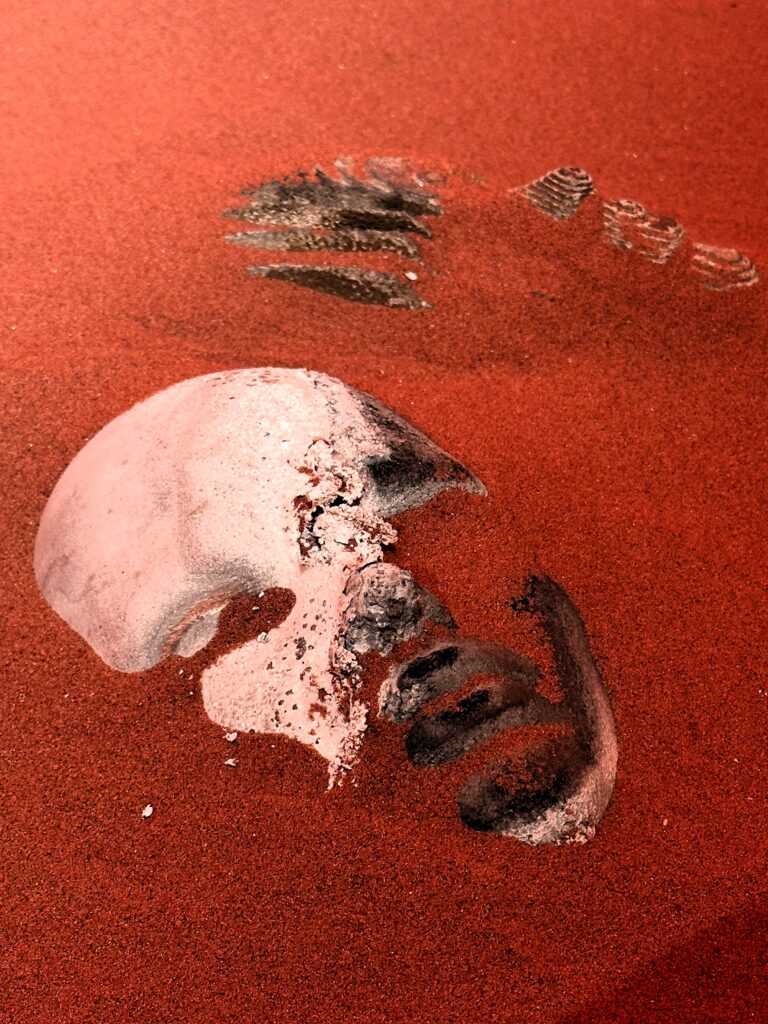
Order of things – first exhibited at Meta Spațiu Timișoara – 2025